
AI Isn’t Replacing Your Value, It’s Moving It
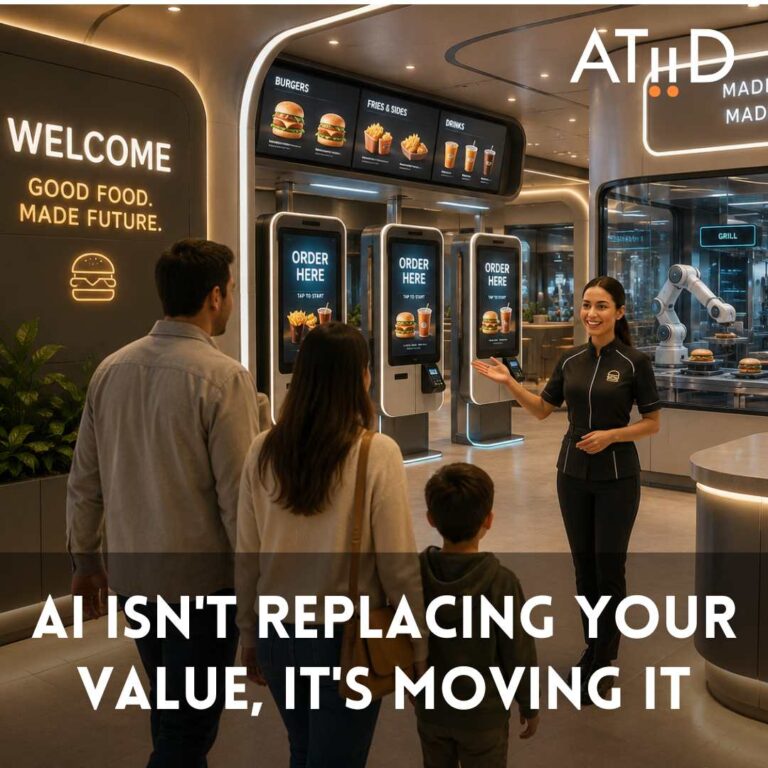
There is a version of the AI conversation that focuses on automation, displacement, and fear. This is not that conversation.
This is a conversation about something that has happened before, many times,
throughout the history of work. Every major technological revolution does not simply eliminate jobs. It relocates value. It shifts where human contribution matters most. And the people who recognize that shift early, and who are willing to move with it, are the ones who define what success looks like on the other side.
AI is the latest version of that shift. And understanding it requires looking back before we look forward.
Every revolution in technology changes what work gets done by machines. Every one of them reveals a deeper, more durable form of human value underneath.
This Has Happened Before
In the late 1800s, the horse-drawn carriage was the backbone of personal transportation. And the industries that supported it required real skill. Wheelwrights crafted wooden wheels with precise tolerances. Harness makers understood leather, tension, and the mechanics of load-bearing. Whip makers, yes, whip makers, were specialized craftspeople whose work required years of training to master. These were not low-skill jobs. They were respected trades. The people who did them did them well, and the economy depended on it.
Then the automobile arrived.
The craftsmanship required to build a carriage did not suddenly become worthless. The underlying skills, precision, mechanical understanding, attention to detail, knowledge of materials and tolerances, were genuinely valuable. But the context those skills lived in changed completely. The new economy did not need more whip makers. It needed people who could master the tools and machines of an assembly line. Who could work with metal, with engines, with emerging manufacturing processes at a scale that handcraft never could.
The people who thrived were not the ones who abandoned everything they knew. They were the ones who looked at what they had built, their discipline, their mechanical intuition, their understanding of how things fit together, and asked how that experience translated into what the new economy actually needed.
That is the question AI is now asking of every white collar professional alive today.
The carriage maker’s skill did not lose its value because it was inferior. It lost its context. AI is doing the same thing to white collar work right now.
The White Collar Era Was Real, And It Is Shifting
The work that defined the modern white collar workforce was genuinely valuable for its era. Managing large volumes of data accurately, building and maintaining complex reporting systems, coordinating information across departments, these were hard problems. Before modern software, they required significant human effort, careful attention, and real expertise to get right.
That value was real. Nobody who spent a career doing that work built it on nothing. They built it on the skills and capabilities that the information age required of them. And they delivered.
But just as the automobile did not invalidate the carriage maker’s skill, it changed the context that skill needed to operate in, AI is now changing where the value in knowledge work actually lives. The data management, the reporting, the process execution that required human effort for decades is increasingly something AI handles faster, more accurately, and without fatigue.
This is not a judgment on the work. It is a description of a shift. The same kind of shift that has happened at every major turning point in the history of human labor. And every time it has happened, the people who got stuck were the ones who confused the task with the value. The people who moved forward were the ones who understood that their real asset was never the task itself, it was the experience, judgment, and understanding they had built through years of doing it.
The Myth of the Premium White Collar Paycheck
There has long been an unspoken hierarchy in the working world. White collar work sits at the top. Blue collar and service work sits lower. And somewhere at the bottom, in the minds of many, sits the fast food worker.
That hierarchy was always more about perception than economic reality. The highest paid people in any era are not the ones with the most prestigious-sounding job titles. They are the ones who bring the most value, or who possess a skill that only a small fraction of the population has.
A surgeon earns what they earn not because of their title but because the skill is rare, the stakes are high, and the judgment required cannot be easily replicated. A great sales leader earns what they earn because they can consistently open doors, build trust, and move people toward decisions in ways that directly drive revenue.
The white collar professional who spent their career managing spreadsheets and generating reports was never in that category. The paycheck felt premium. The work felt professional. But the premium was tied to the information management complexity of the era, not to a uniquely human skill. And that era is ending.
Here is the hard truth: in the not-too-distant future, a lot of the work that white collar professionals have been paid well to do will be seen the way those same professionals currently see fast food work. Not because it was without dignity, but because it will be done faster, cheaper, and more accurately by a machine.
The Fast Food Lesson Nobody Saw Coming
Speaking of fast food, let us talk about Chick-fil-A for a moment.
By almost every metric that should not work in fast food, Chick-fil-A should not be the industry leader. They are closed on Sundays. They have fewer operating days than every major competitor. Their menu is narrower. Their price point is higher.
And yet they consistently generate more revenue per restaurant than McDonald’s, Starbucks, and virtually every other chain in the country. Not despite being closed on Sundays. Not despite their smaller menu. Because of what they put at the center of their model: the human experience of being served by someone who genuinely gives a damn.
The Chick-fil-A employee is trained to make eye contact, to say “my pleasure,” to treat every customer like they matter. That sounds small. It is not small. It is the entire differentiator. And it is working at a scale that no competitor has been able to replicate, even with more locations, more hours, and more resources.
Now consider what happens as AI and robotics move into fast food. Order-taking kiosks. Automated fryers. Inventory systems that never make mistakes. The operational efficiency of the fast food kitchen will increasingly be handled by machines.
What will remain, and what will separate the winners from the losers, is exactly what Chick-fil-A figured out years ago: the human being standing between the operation and the guest. Not to take the order. Not to cook the food. To make the experience worth returning for.
The work that people have looked down on is about to reveal what they missed: the human connection was always the premium part.
What Actually Makes You Valuable
So if the job title is not the asset, and the routine work is going to AI, what is left?
The answer has been consistent throughout every era of economic disruption, even if it has not always been articulated clearly: the people who create the most value are the ones who can think strategically and influence others.
Not one or the other. Both.
Strategic thinking means being able to look at a situation, incomplete information, competing priorities, uncertain outcomes, and make a sound judgment call. It means understanding not just what is happening, but why it matters and what should happen next. It means being the person in the room who can take AI’s analysis, stress-test the assumptions, and decide what the organization is actually going to do.
Influence means being able to move people. To communicate with clarity. To build trust across relationships. To get buy-in for a direction that is hard, to have a difficult conversation that needs to be had, to inspire a team that is uncertain. These are not soft skills. They are the hardest skills. And they are the ones that AI is furthest from replicating.
The experience you have built over your career is not irrelevant. It is actually the raw material for both of these capabilities, if you choose to invest in developing them. The person who spent fifteen years in operations does not just know the workflow. They know why decisions were made, what went wrong, what the organization has tried before, and what the people on the floor actually need. That contextual intelligence, applied strategically, is worth far more than the ability to run the reports that documented it.
The Shift That Needs to Happen
If you own or run the business, this shift lands on you first.
For years, payroll has been treated as a cost to manage down. AI is about to make that instinct dangerous. The owners who win will not be the ones who cut the most people. They will be the ones who looked at their team and saw an appreciating asset hiding in plain sight.
Stop asking: which roles can I automate away?
Start asking: what does my business need next, and which of my people already have the experience to grow into it?
That is a different question. It is harder. And it is the one that separates the businesses that come out of this stronger from the ones that quietly hollow themselves out.
Your fifteen-year operations person does not just know the workflow. They know why decisions were made, what has already failed, and what the floor actually needs. AI can run the reports that person used to run. It cannot replace the judgment they built running them. Your job is to move that judgment to where it now matters most, and to redesign the roles around it.
This is the Chick-fil-A decision, made at the ownership level. Chick-fil-A did not win by cutting people to the bone. They won because someone at the top decided the human experience was the product, then built the roles and the training to deliver it. That was a deliberate choice by leadership, not an accident on the floor.
You will have to make the same kind of choice: which work goes to the machine, which work stays human, and how you develop your people into the roles that only a person can fill.
But you do not have to figure that out alone.
Ready to Build What AI Cannot Replace?
At ATiiD, we help business owners make exactly this transition. Not just adopting AI tools, but deciding what work goes to the machine, what work stays human, and how to develop the people you already have into the roles that will define who wins in the years ahead.
Our services are built for the decisions you’re about to make:
- AI Leader Launch Program: A focused 2-hour executive workshop that gets your leadership team aligned on AI strategy before you spend a dollar on tools
- Workforce Training: Build the critical thinking, prompt skills, and judgment your team needs to use AI effectively and responsibly
- Business Process Optimization: Map where AI should take over, and where human judgment must remain in the loop
- Future State Analysis: Design the workforce your business needs for the next five years, not just today
- Roadmap & Implementation: Move from vision to execution with a clear, people-centered AI adoption plan
The owners who win with AI will not be the ones who replaced the most people. They will be the ones who developed the best ones.
Let’s build that together.