
Why AI Answers Might Not Feel Right (Yet)
As companies gain deeper insights into their operations through AI and advanced analytics, something surprising is happening: the answers they’re getting… feel wrong.
Not because they are wrong, but because they feel different from the way humans have historically made decisions.
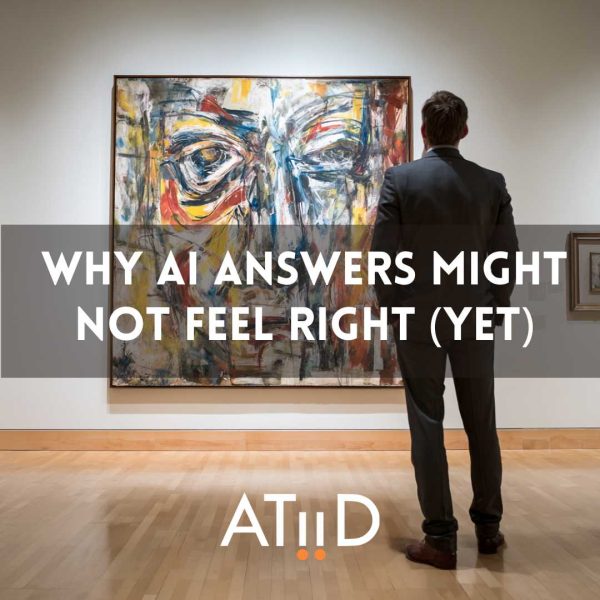
Emotional Decision-Making vs. Pattern-Based Intelligence
Humans are emotional creatures. Even in business, we often make decisions based on gut feeling, past experience, or internal consensus, none of which are inherently bad. But AI doesn’t have a gut. It doesn’t care about “how things have always been done.” It simply analyzes the data, identifies patterns, and returns the outcome most likely to achieve a stated goal.
That’s why some AI insights may clash with long-held assumptions or feel counterintuitive. But more often than not, these unexpected results are better aligned with business objectives.
The Shift in Perspective: From Resistance to Curiosity
To truly benefit from AI, companies need to shift their mindset. If your first reaction is to dismiss AI recommendations because they feel off, take a step back. Ask: Are these insights more directly connected to what we’re trying to achieve? In many cases, the answer is yes.
This is the growing pain of becoming a data-driven organization, realizing that your instincts may not always be your best guide anymore.
Trust Is Earned (and Built)
We understand the challenge. Trusting a machine is hard, especially when it seems to contradict what your team “just knows.” That’s why it’s crucial to build systems that allow for:
Validation workflows: Let employees check and confirm AI output before taking action.
Transparency in logic: Make it clear how the AI came to its conclusions.
Trackable experiments: Pilot AI recommendations in smaller areas of the business and measure the results.
When people see consistent improvement, trust builds naturally.
Hallucinations Happen, So Build in Guardrails
No AI is perfect. Especially large language models (LLMs), which can sometimes generate inaccurate or made-up information. That’s why you need a human-in-the-loop approach. AI can generate insights, but people must review, verify, and contextualize those insights, at least for now.
The good news? AI gets better over time. The more data you feed it, and the more feedback loops you provide, the more accurate and useful it becomes.
Culture Eats Algorithms for Breakfast
Ultimately, the biggest challenge isn’t the tech, it’s the culture.
Organizations that empower employees to try new tools, ask better questions, and take calculated risks will thrive in this new era. Those that cling to “how we’ve always done it” risk being outpaced by competitors who are more curious, more agile, and more willing to explore what the data is really saying.
Let Insight Change You
AI will show you things you didn’t expect. The question is: will you be ready to act on them?
Instead of ignoring what doesn’t feel familiar, ask yourself if it’s pointing you somewhere new—and potentially better.
Because in the world of AI, the real winners aren’t the ones who guess right—they’re the ones who listen better.
If you’d like help building a culture and infrastructure that supports AI-driven insights while still protecting your people’s judgment and experience, ATiiD can help. Let’s talk about how to make AI a trusted part of your decision-making process, without losing what makes your business human.