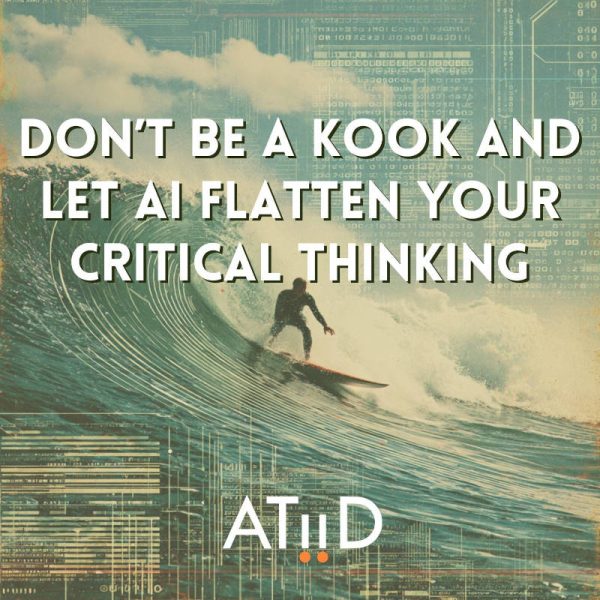
Don’t Be a Kook And Let AI Flatten Your Critical Thinking
Kook is surfer-speak for someone clueless in the lineup, out of sync, unaware of the waves, and putting themselves or others at risk. Using that metaphor, are you relying too heavily on AI? That’s the mental equivalent of being a kook. Renew your awareness, or face a wipe-out.
The Warning Signs: When AI Starts to Dumb You Down
Recent studies suggest heavy AI tool use can weaken our ability to think critically and solve problems:
- One Phys.org article reported a strong negative correlation between frequent AI use and critical thinking scores (correlation = –0.68), especially among younger users – phys.org
- HTEC warns that while AI boosts efficiency, it may also diminish our problem-solving skills over time – htec.com
- A joint Microsoft–Carnegie Mellon study found that confidence in AI led to reduced critical thinking among knowledge workers – techenclave.com
These findings echo a larger concern: that our brains begin to “offload” reasoning to AI, leaving us less capable of independent thinking, straight into kook territory.
What's Really Happening?
This isn’t just about forgetting facts, it’s about “cognitive offloading”. When you rely on AI for answers, your brain gets out of the mental exercise routine and muscles that aren’t used wither. Imagine a surfer who stops paddling. Pretty soon, they can’t catch a wave.
Picture this: A marketing director can’t start a campaign without ChatGPT outlining it first. A developer reflexively pastes every error into AI instead of reading the stack trace. A student stares blankly at an essay prompt, waiting for AI to structure their thoughts. These aren’t efficiency gains; they’re warning signs of cognitive dependence.
AI’s gloss and speed make it tempting to skip the mental effort. But just like skilled surfers spend hours mastering their paddling and balance, not just catching waves, the mental workouts matter. When the swell shifts or a rogue wave hits, it’s your own judgment that keeps you upright, not the board. Same goes for AI. When results get choppy, you’ll need sharp thinking to ride it out.
Navigating the Cultural Shift: Education and Business in the AI Wave
The rise of AI demands a fundamental cultural shift in how we approach both learning and work. This isn’t just about adopting new tools; it’s about reimagining our relationship with thinking itself.
Rewriting the Curriculum for Tomorrow's Thinkers
Our current education system was built to produce workers for an industrial economy, people who could reliably follow instructions and complete repetitive tasks. But in a world powered by AI and automation, those days are behind us. What we need now are strategic thinkers who can navigate complexity, think critically, and separate signal from noise in an ocean of information.
Schools must go beyond rote memorization and standardized testing to teach the art of questioning, pattern recognition, and data validation. Students must learn to identify hazards, not just in AI outputs, but in the messy, unpredictable problems of everyday life. When the wifi crashes mid-presentation, when a key team member calls in sick, when the data doesn’t match expectations; these are the rogue waves that reveal whether we’ve maintained our problem-solving muscles.
We need to teach improvisation alongside information, building comfort with choppy conditions and the confidence to navigate without a digital compass. Because when AI hits its limits, and it will, students need the intuition of experienced surfers who can read the water: knowing when to trust the forecast (AI), when to trust their own eyes, and when to paddle over to more experienced surfers for advice.
From Task Performers to Strategic Thinkers in Business
Just as education must evolve, business leaders face their own transformation. In an AI-enhanced workplace, success comes from viewing employees not as task performers, but as mini-entrepreneurs; individuals capable of thinking strategically, identifying opportunities, and driving innovation from within.
Clinging to rigid hierarchies and micromanagement will only slow progress in this new landscape. Instead, create a culture that empowers employees to think like business owners, take calculated risks, and learn through action. Mistakes will happen, but in a fast-moving, AI-enhanced environment, they can be corrected just as quickly, often with minimal impact.
What matters most is building teams that combine AI’s capabilities with irreplaceable human judgment, because the organizations that master this balance will outmaneuver those that become over-dependent on either extreme.
Don't Wipe Out: Stay Sharp With These Strategies
- Treat AI Like a Sidekick, Not a Pilot
Use AI to gather info or generate drafts, but you lead the decision-making and creativity. Instead of “Write me a strategy document,” try “What questions should I consider when developing a strategy for X?” Let AI interview you, not replace you. - Practice Active Thinking
Don’t let AI do all the work. Before asking AI, sketch your own solution first, even if it’s rough. Then use AI to pressure-test your thinking: “What’s wrong with this approach?” or “What am I missing?” This builds your judgment while leveraging AI’s breadth. - Validate Before You Accelerate
Build a verification step into your workflow. Cross-reference AI outputs with primary sources, run key decisions by a colleague, or simply ask AI to argue the opposite position. Speed without accuracy is just fast failure. - Apply Tech With Strategy
Question why you’re implementing AI, how it fits your processes, and where human oversight is essential. Map out which decisions need human judgment (hiring, strategy, creative vision) versus which can be AI-assisted (data analysis, first drafts, research). - Schedule AI-Free Deep Work
Block time for thinking without digital assistance. Whether it’s morning planning with pen and paper or walking meetings without devices, these spaces let your brain do what it does best: connect dots AI might miss.
The Competitive Edge: Why Critical Thinkers Will Dominate
AI isn’t replacing intelligence, it’s revealing where we’ve stopped thinking nypost.com. Left unchecked, that’s a dangerous ride. But there’s hope: if you pair AI’s power with deliberate thought, you create an unbeatable combination.
Here’s the competitive truth: As more people become AI-dependent, those who maintain their critical thinking skills while leveraging AI will have unprecedented advantages. They’ll spot opportunities others miss, solve problems others can’t even frame, and lead teams through complexity while others wait for AI to show the way. In a world of cognitive outsourcing, the ability to think independently becomes the ultimate differentiator. washingtonpost.com
Final Take: Ride the AI Wave Without Being a Kook
AI can be your ally if you use it wisely and think alongside it. That means staying curious, questioning outputs, and keeping your mental gear in shape.
Don’t let AI surf for you, or you’ll wipe out in the critical moments. Instead, use AI to elevate your mind, not erase it. The future belongs to those who can dance with AI without losing their own rhythm; those who stay sharp enough to know when to paddle hard and when to ride the wave.
At ATiiD, we help organizations navigate the AI wave without wiping out their critical thinking. If you’re ready to empower your team to think strategically, validate information, and integrate AI the right way, let’s talk. We’ll help you build systems that move fast and stay smart.