
Three Businesses and an LLM
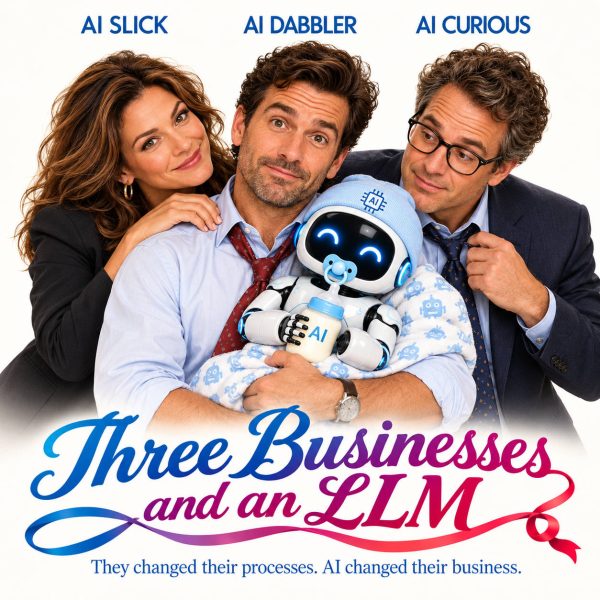
If you remember the 1987 movie Three Men and a Baby, three very different guys suddenly found themselves dealing with something none of them were quite prepared for.
Welcome to business in the age of AI.
For most of modern business history, having better technology gave you an advantage. You had faster computers, better software, better manufacturing equipment, or access to information your competitors didn’t have. Technology itself could be the differentiator.
AI changes that equation.
Eventually, almost every business will have access to incredibly powerful AI. Your competitors will be using many of the same large language models, AI agents, automation platforms, and analytical tools you are. The underlying technology will become increasingly available to everyone.
So if everyone has access to similar intelligence, where does the competitive advantage come from?
People.
More specifically, it comes from how well you’ve designed your people, processes, and AI systems to work together.
Let’s look at three hypothetical businesses that are all handed essentially the same AI capabilities.
Business #1: The Company That Redesigns Around AI
The first company doesn’t start by asking, “Which AI tools should we buy?”
It asks, “How should our business work differently now that these capabilities exist?”
Leadership analyzes its processes before deploying AI. It identifies repetitive work that can be automated, but it doesn’t stop there. It asks what employees should be doing with the time automation gives back to them.
Job descriptions change.
Processes change.
Performance measurements change.
Employees receive training on how to work with AI, validate its outputs, manage AI agents, and think more strategically about the business.
Instead of having a salesperson spend hours researching prospects, AI does the research while the salesperson spends more time developing relationships and figuring out how to win difficult accounts.
Instead of having an analyst spend days gathering information for a report, AI gathers and organizes it while the analyst focuses on what the information actually means.
Eventually, employees may oversee multiple AI agents performing different pieces of a larger process. The human becomes less of a task worker and more of a conductor, directing technology toward a business outcome.
This company isn’t simply adopting AI.
It’s redesigning itself around what AI makes possible.
And every time AI gets better, this company is positioned to take advantage of it.
Business #2: "Here's AI. Go Experiment."
The second company also recognizes that AI is important.
Leadership buys licenses for the latest AI tools, sends everyone an email announcing them and says:
“Start experimenting with AI and see what you can do.”
That’s better than doing nothing.
Some employees will become power users. They’ll discover ways to save hours every week. Others will occasionally use AI to write an email or summarize a document. Some won’t use it at all.
Eventually, you’ll have pockets of impressive AI adoption scattered throughout the company.
But there’s a problem.
The business itself hasn’t changed.
The same processes remain in place. The same job descriptions remain. The same approval structures remain. The same performance metrics remain.
Employees are essentially being asked to bolt 2026 technology onto a business designed around the way people worked years ago.
There will probably be productivity gains, but they will be inconsistent. One department may transform while another barely changes.
The company has adopted AI tools without becoming an AI-enabled organization.
Business #3: The AI Dabbler
Then there’s our third business.
Leadership knows AI is important because everyone keeps talking about it.
Someone uses ChatGPT.
Marketing experiments with AI-generated content.
IT tries an AI tool.
Someone attends a conference and comes back excited about agents.
Six months later, another AI initiative gets launched.
There’s plenty of activity, but no larger strategy connecting any of it.
This company is confusing AI activity with AI transformation.
They may even look around and think they’re keeping up because they’re “using AI.”
Meanwhile, Business #1 has redesigned entire workflows.
That’s when the gap becomes dangerous.
Same AI. Very Different Businesses.
Here’s what’s interesting about our three companies.
They may all have access to essentially the same technology.
The difference isn’t necessarily the LLM.
It’s what surrounds the LLM.
Business #1 has redesigned its processes, developed its people, organized its data, captured institutional knowledge, and created a structure where humans and AI complement one another.
Business #2 has good technology sitting inside an old operating model.
Business #3 has technology scattered around the organization without a clear destination.
The competitive advantage increasingly becomes the human and organizational system built around AI.
Human Capital Will Become More Valuable, Not Less
There’s a tendency to assume that increasingly capable AI means people become less important.
I think the opposite may happen.
If everyone eventually has access to similar AI capabilities, then the technology itself becomes less of a differentiator.
The difference becomes the people directing it.
Who asks better questions?
Who recognizes when the AI is wrong?
Who understands the customer?
Who sees an opportunity buried inside the data?
Who can connect three seemingly unrelated ideas and turn them into a new business model?
Who knows which AI agents should be working together?
Who understands the company’s history well enough to know why something that looks good on paper probably won’t work?
That’s human capital.
AI can dramatically amplify it, but amplification works both ways.
Give a great strategic thinker powerful AI and you may dramatically increase that person’s impact.
Give someone poor direction and unlimited AI capabilities and you may simply allow them to make bad decisions much faster.
The Real Risk Is Your Competitor Figuring This Out First
This is where AI adoption becomes more serious.
Imagine Business #2 competing against Business #1.
At first, the difference may not look dramatic.
Then Business #1 begins completing work faster. Its employees handle more customers. Decisions happen sooner. Institutional knowledge becomes easier to access. Its AI systems improve. Its people become increasingly comfortable managing AI agents.
Then another generation of AI arrives.
Business #1 plugs those capabilities into processes already designed for AI.
Business #2 has to figure out how to reorganize itself before it can fully use them.
The gap compounds.
Eventually, the problem isn’t that your competitor bought better AI.
They built a better business around AI.
At that point, buying the same software may not help you catch them.
Don't Just Buy the Baby
The lesson from our three businesses is pretty simple.
AI adoption isn’t ultimately about buying AI.
It’s about deciding what your organization should look like when intelligence, automation, and information become abundant.
Technology will continue getting better, and many of those capabilities will eventually become available to everyone.
Your competitive advantage will come from what you build around them: your processes, your data, your institutional knowledge, your culture, and most importantly, your people.
The companies that recognize this early won’t simply have better AI.
At ATiiD, we help organizations look beyond the AI tool itself and redesign the people, processes, data, and workflows around it. If you’re ready to determine what your next-generation business should look like, let’s build the roadmap before your competitors do.