Will AI Create Too Many Cats?
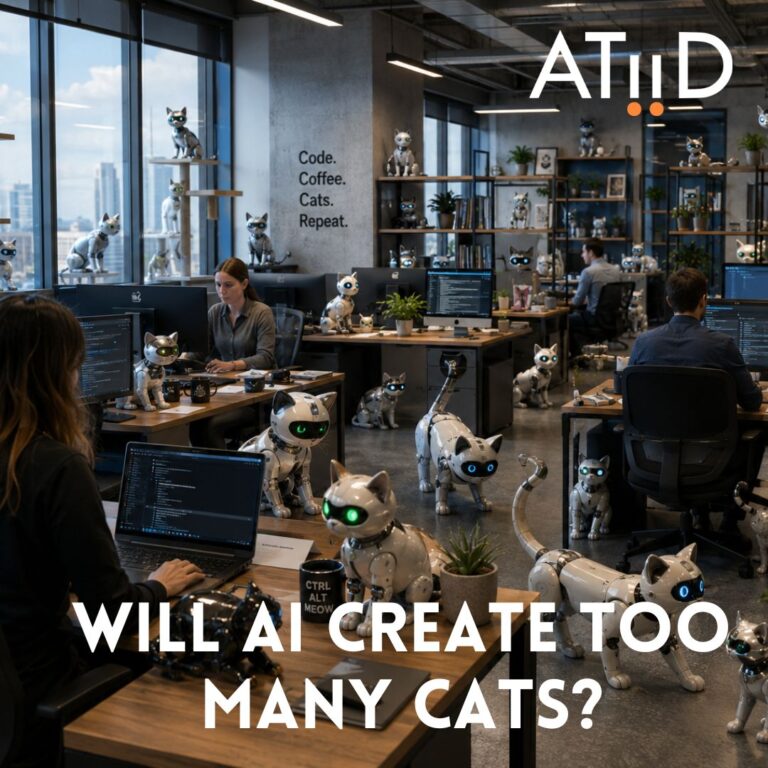
There is a moment that happens in almost every organization that starts taking AI seriously. It begins well. A few people discover tools that genuinely help them work faster. Word spreads. Others start experimenting. Before long, half the company is using AI in some form, different tools, different approaches, different prompts, different workflows, each producing different outputs. It’s become like herding cats.
It looks like progress. And in a narrow sense, it is.
But step back and look at the whole picture, and what you actually have is a room full of cats going in different directions. Some are delivering real value. Some are producing confident-sounding noise. Most leaders have no idea which is which, because nobody set up a system to tell them.
This is where AI adoption quietly starts to fail. Not with a dramatic collapse, but with a slow accumulation of disconnected activity that never compounds into organizational capability. And by the time most companies realize it’s happening, the cost of making sense of it all has become very large.
The Agentic Era Makes This Worse, Faster
For a while, AI tools were relatively contained. People used chatbots to draft emails or summarize documents. The outputs were visible, the stakes were manageable, and the variation between what one person did and what another did was mostly harmless.
That era is ending.
The rise of agentic AI, tools like Claude’s Cowork, autonomous agents that don’t just respond to prompts but take sequences of actions, make decisions, and execute multi-step workflows on behalf of the user, fundamentally changes the scale of the problem. When AI is drafting an email, the variation between employees is a nuisance. When AI is executing business processes, managing data, coordinating tasks, and making decisions across systems, the variation between employees becomes a structural risk.
Think about what happens when ten people on the same team are each running their own AI agent with their own instructions, their own data sources, their own definitions of what a good output looks like, and their own thresholds for when to act. Each of them thinks they are being efficient. And each of them is right, individually. But the outputs they are generating are moving in ten different directions, built on ten different foundations, with no shared standard for quality, accuracy, or alignment with the organization’s actual goals.
That’s not ten people being productive. That’s ten cats.
When AI was answering questions, variation was manageable. When AI is executing workflows, variation is a liability.
The Data and Process Disconnect
The cat problem has two dimensions that tend to develop in parallel, and both need to be addressed.
The first is data. When individuals are running their own AI tools without shared standards, they are feeding those tools different data, sometimes from different sources, sometimes structured differently, sometimes with different levels of accuracy and completeness. The outputs those tools generate are only as good as what went in. And when nobody has established what good input looks like, the outputs across the organization become impossible to compare, aggregate, or build on.
A sales team where five people are using AI to analyze customer data will end up with five different pictures of the same customer, if each person is pulling data differently, cleaning it differently, and prompting their AI differently. None of those pictures is wrong per se. But none of them is the organizational view, either. And decisions made from five different pictures of the same customer are not better decisions. They are noisier ones.
The second dimension is process. AI is genuinely surfacing things that work, faster ways to research, smarter ways to structure proposals, better ways to synthesize information, more effective ways to communicate. But when those discoveries happen at the individual level and stay there, they don’t compound. The person who found a better way keeps using it. Everyone else keeps doing it the old way. The organization gets the improvement once instead of everywhere.
This is one of the most underappreciated costs of ungoverned AI adoption: the opportunity cost of not capturing what’s working and scaling it. Every week that a better approach lives in one person’s workflow instead of the whole team’s is a week of compounding advantage that never happens.
What Herding Cats Actually Costs
Leaders who are watching their teams adopt AI rapidly sometimes feel like the right move is to let it run, to let people experiment, find what works, and figure it out organically. And there is some wisdom in that instinct. Rigid, top-down AI mandates that ignore how people actually work tend to fail just as badly as no governance at all.
But there is a difference between structured experimentation and unconstrained noise. And the bill for unconstrained noise tends to arrive in several forms:
- Redundant tool spend – multiple teams purchasing overlapping AI subscriptions that do roughly the same thing, because nobody has visibility into what anyone else is running
- Quality inconsistency – outputs that should represent the organization varying wildly in accuracy, tone, and reliability depending on who produced them and what tool they used
- Security and compliance exposure – sensitive data being fed into AI tools that were never vetted, with outputs going to places they were never supposed to go
- Institutional knowledge that stays individual – discoveries about what works with AI that never get shared, documented, or built into the way the organization operates
- Governance debt – the longer an organization waits to establish standards, the more embedded the variation becomes, and the harder and more expensive it is to unwind
That last point is the one that catches most organizations off guard. Governance feels like overhead when AI adoption is young and the energy is high. It feels like a crisis when AI adoption is mature and the chaos has compounded into something that is genuinely hard to untangle.
The companies paying the lowest price for AI governance are the ones that built it early, when the system was small enough that setting standards was straightforward, the tools were few enough that alignment was achievable, and the habits were new enough that they could still be shaped.
Governance feels like overhead on day one. It feels like a rescue operation on day three hundred. The difference in cost between those two moments is enormous.
What Good Governance Actually Looks Like
The goal of AI governance is not to slow adoption down. It is to make the adoption that happens actually stick, to ensure that when AI delivers value for one person, it delivers value for the whole organization, and that when it produces risk for one person, it doesn’t become risk for everyone.
Good AI governance at the organizational level has a few non-negotiable components:
- A shared tool standard – not necessarily one tool for everything, but a clear framework for which tools are approved for which purposes, and why
- Data input standards – clear guidelines on what data can be fed into AI systems, how it should be structured, and what sources are trusted
- Output review processes – defined checkpoints where AI-generated outputs are validated before they are acted on, especially for high-stakes decisions
- A feedback loop – a mechanism for capturing what’s working across the organization, sharing it, and incorporating it into standard practice faster than organic word-of-mouth would allow
- Leadership alignment – executives and managers who understand enough about what their teams are doing with AI to ask the right questions, set the right expectations, and redirect when something is off track
None of these require a large bureaucracy. In a smaller organization, a good AI governance framework can be as simple as a shared document, a monthly team conversation, and a designated person responsible for keeping it current. What matters is not the complexity of the system, it is that the system exists, that people know about it, and that it is treated as a living document rather than a one-time exercise.
The organizations that get this right build a compounding advantage that is very hard to replicate. Every improvement one person finds gets captured. Every risk one person encounters gets flagged. The whole organization learns at the speed of its fastest learner, instead of at the average speed of everyone figuring it out separately.
Move Before the Noise Gets Loud
The time to build AI governance is before you need it badly. Not because the future is uncertain, it is not. Agentic AI tools are going to proliferate. Your employees are going to adopt them with or without a framework. The question is not whether the cats will multiply. The question is whether you are going to build the structure to channel that energy before it becomes chaos, or after.
After is always more expensive. The data standards that should have been set in month one become a data cleanup project in month twelve. The tool rationalization that should have happened early becomes a rip-and-replace initiative that disrupts workflows that people have built their days around. The governance debt that accumulated while everyone was experimenting becomes a consulting engagement to untangle what should have been straightforward from the start.
The organizations that will look back on this period as a competitive advantage are not the ones that adopted AI the fastest. They are the ones that adopted it the most intentionally, that moved quickly enough to capture the productivity gains, and deliberately enough to make those gains stick, scale, and compound.
That is the difference between a room full of productive, aligned people using AI well and a room full of cats. Both rooms look busy. Only one of them is building something.
The organizations that win with AI aren’t the fastest adopters. They’re the most intentional ones, and intentionality requires a structure to operate inside of.
ATiiD Helps You Build the Structure Before the Noise Takes Over
If your organization is in the early stages of AI adoption, or if you suspect the cats are already multiplying, ATiiD can help you build the governance, processes, and human capability that turns individual AI activity into organizational AI advantage.
We work with leadership teams to:
- Assess where AI is already being used across the organization and what’s actually working
- Build governance frameworks that enable experimentation without creating chaos
- Establish data and process standards that make AI outputs consistent, reliable, and scalable
- Develop the leadership understanding needed to direct AI strategy, not just react to it
- Create feedback loops that capture what’s working and scale it faster than organic adoption ever could
The best time to build this structure was at the beginning of your AI journey. The second best time is now, before the noise gets loud enough that untangling it becomes the project.