
The New Math of Work: Balancing AI Token Costs with Human Salaries
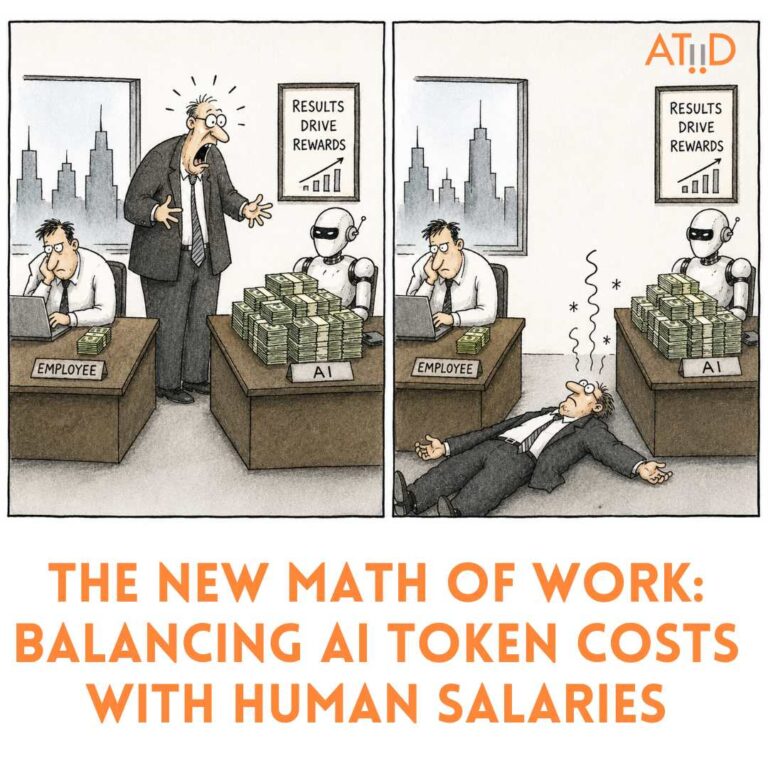
There’s a story making the rounds about a company that laid off a large group of developers because its AI usage had become so extensive that the cost of tokens, combined with employee salaries, was no longer sustainable. It sounds like the kind of story you’d dismiss as an exaggeration, the kind that gets repeated so often that no one remembers where it started.
We decided to dig deeper. It turns out the story is true. And it’s not an isolated case.
The Bill Is Real. Here's the Evidence
Over the past few months, some of the largest technology companies in the world have run head-first into a problem that wasn’t supposed to exist: AI got expensive enough to rival, and in some cases exceed, the cost of the human labor it was supposed to offset.
Microsoft reportedly canceled most of its direct Claude Code licenses and shifted engineers to GitHub Copilot CLI, just six months after rolling the tool out broadly to thousands of employees. The scale of usage became too costly to sustain. Around the same time, software engineering accounted for more than 40% of Microsoft’s layoffs in Washington state. Source: Fortune
See also Bloomberg’s reporting on Microsoft layoffs hitting coders hardest as AI costs rise.
Uber’s CTO said the company burned through its entire annual AI coding budget in just a few weeks, after running internal leaderboards that encouraged employees to use AI as much as possible. A four-person team at the startup GetSwan reportedly spent over $113,000 on AI tools in a single month. Source: Tom
Even Nvidia — the company that makes the chips powering all of this, isn’t immune. An Nvidia executive recently said that within his team, AI compute now costs more than the human workers using it. Meanwhile, Nvidia’s CEO has said engineers should be consuming AI tokens worth roughly half their annual salary to be considered fully productive. Source: Tom
These aren’t fringe cases. These are the companies with the most resources, the most leverage with AI providers, and the most experience deploying technology at scale, and they’re still getting caught off guard by the bill.
AI didn’t make the cost equation go away. It just moved the cost from a line item called “salaries” to one called “tokens.” And right now, a lot of companies are paying both.
This Is Not a New Problem. It's an Old One Wearing New Clothes
Every major shift in business technology has come with a version of this exact moment. New tools arrive promising to do more for less. Companies rush to adopt. And somewhere in that rush, the actual cost of running the new tool at scale gets underestimated, sometimes badly.
Manufacturers who adopted early automation didn’t just buy a machine and walk away. They had to account for maintenance, downtime, retraining, and the ongoing cost of running equipment that needed constant tuning to stay efficient. Companies that moved to cloud computing in the 2010s told a similar story, the promise of “unlimited scale” came with unlimited bills for companies that didn’t manage their usage carefully.
AI is following the same pattern, just faster and at a larger scale. The difference is that AI tokens are consumed continuously, by every employee, on every task, all day long. A piece of factory equipment runs on a schedule. An AI assistant runs every time someone has a thought worth typing into a prompt box.
That’s not a reason to slow down on AI. It’s a reason to manage it like the real cost center it is, because it is one, and pretending otherwise is exactly how companies end up with six-figure monthly bills they didn’t see coming.
The New Math of Workforce Planning
Here is the shift every business leader needs to internalize: AI tokens are no longer just a software expense. They are becoming part of the cost-of-labor conversation, right alongside salaries, benefits, and overhead.
That doesn’t mean AI isn’t worth it. The productivity gains are real. A well-deployed AI tool can absolutely make one person capable of the output that used to take two or three. But “more output” only translates to “more profit” if the cost of producing that output, salary plus AI usage, stays below the value being created.
Businesses have navigated this kind of math for as long as businesses have existed. Every era has had its version of the question: how much does it cost to produce a unit of value, and is that cost going down or up? What’s different now is that the AI side of that equation is volatile, usage-driven, and, as Microsoft, Uber, and others have discovered, capable of moving a lot faster than payroll ever could.
The companies getting burned right now aren’t the ones using AI. They’re the ones using it without a budget, a strategy, or a plan for what “enough” looks like.
Fine-Tuning Both Sides of the Equation
The path forward isn’t choosing between people and AI. It’s getting deliberate about how both are deployed, and recognizing that both sides of this equation need ongoing tuning, not a one-time decision.
On the technology side, that means treating AI usage the way you’d treat any other operational expense: with visibility, guardrails, and a clear sense of what tasks justify what level of AI spend. Not every task needs the most expensive model running at maximum capacity. Some research referenced above points to a coming shift toward smarter, more deliberate AI usage, the era of unrestricted access for everyone, on everything, may already be ending at the companies that got burned first.
On the human side, it means being thoughtful about where people’s time and salary are best spent. If AI can reliably and affordably handle a category of work, that’s a signal to shift the people who used to do that work toward higher-value activities, not necessarily a signal to eliminate the role entirely. The goal is for every dollar of salary and every dollar of token spend to be pointed at the work that actually moves the business forward.
This is precisely the kind of recalibration that requires both a technology strategy and a workforce strategy, developed together, not in separate silos. A technology team optimizing for token efficiency without understanding the business impact of the work being done is just as risky as a leadership team mandating AI adoption without understanding what it will cost to sustain.
The Businesses That Win This Round
The companies currently making headlines for AI cost overruns aren’t failures, they’re early movers who are now doing the hard, necessary work of figuring out sustainable AI usage. The businesses that watch this unfold and build their AI adoption with cost awareness from day one will skip the expensive lesson entirely.
That means asking the right questions before AI tools roll out broadly: What tasks justify the spend? What does success look like in terms of output per dollar, across both salary and token cost? Who owns the ongoing tuning of both the technology and the team using it?
These are not questions that get answered once. They get revisited continuously, the same way smart businesses have always revisited their cost structures as conditions change. AI just made the cycle faster.
The future of work isn’t AI versus people. It’s AI and people, fine-tuned together, with a leadership team that knows how to balance the books on both.
Build an AI Strategy That Balances the Books
At ATiiD, we help businesses avoid the expensive trial-and-error that’s playing out at some of the world’s largest companies right now. We help you understand where AI genuinely adds value, what it will cost to sustain that value, and how to structure your workforce so that people and AI are both operating where they’re worth the most.
Our services are built for exactly this kind of planning:
- AI Leader Launch Program: A focused 2-hour executive workshop to align your leadership team on AI strategy, including the cost realities, before you scale adoption
- Workforce Training: Develop the judgment your team needs to use AI efficiently, not just frequently
- Business Process Optimization: Identify where AI delivers real ROI and where the cost-to-value ratio doesn’t yet make sense
- Future State Analysis: Design a workforce and technology budget model that scales sustainably as both costs and capabilities evolve
- Roadmap & Implementation: Move forward with a plan that accounts for the full cost of AI adoption, not just the sticker price
The businesses making headlines this year learned this lesson the hard way, and at enormous cost. Yours doesn’t have to.