
Your Ring Is Only as Powerful as Your Thinking: What Green Lantern Teaches Us About AI
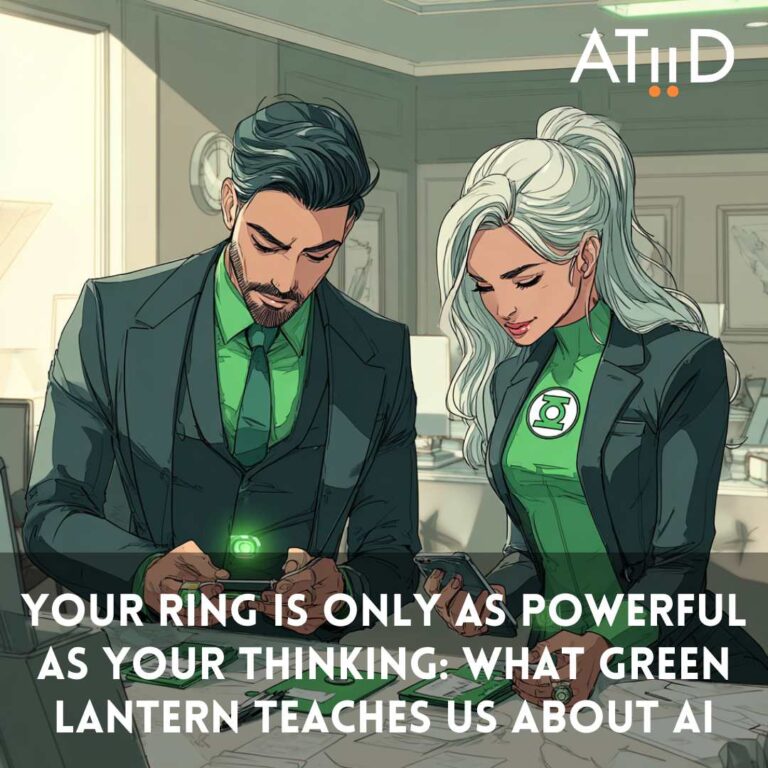
In a world where AI can build almost anything you ask it to, the real question is whether you’re asking the right things.
If you grew up reading DC Comics, you know the Green Lantern mythology. A member of the Green Lantern Corps is given a power ring, one of the most powerful weapons in the universe. The ring can create anything the wearer can imagine. Force fields. Weapons. Constructs of impossible scale and complexity. There is virtually no limit to what can be built.
Except one.
The ring is only as powerful as the mind wielding it. The Corps doesn’t just hand the ring to anyone with a pulse. It seeks out individuals with exceptional willpower, and critically, the ability to think under pressure. To assess a situation accurately. To imagine a solution that actually fits the problem.
A Green Lantern who panics constructs the wrong thing. A Green Lantern who misreads the situation builds something useless. A Green Lantern who doesn’t understand the problem at all? They might build something that makes it worse.
Sound familiar?
AI is the ring. Critical thinking is the power source. And right now, most organizations are handing out rings without training the Lanterns.
The Most Powerful Tool in the Room Doesn't Think for You
We are living through the most significant shift in workplace capability in a generation. AI tools can draft, analyze, research, summarize, generate, model, and predict at a speed and scale no human can match alone. Ask them the right question and the output can be extraordinary.
But here’s what doesn’t get said enough: AI does what it’s directed to do. It generates based on the inputs, the framing, and the intent it receives. It doesn’t inherently understand your business context, your competitive landscape, your team dynamics, or the real reason a problem exists in the first place.
That part, the diagnosis, the framing, the judgment call about what problem you’re actually trying to solve, is still entirely human.
The Green Lantern doesn’t point the ring at a situation and say “fix this.” The Lantern evaluates the threat. Considers the stakes. Weighs the options. And then manifests something precise and purposeful. The ring executes the vision. The Lantern supplies the vision.
That’s the model. And it’s exactly how AI works in practice.
What Critical Thinking Actually Means in an AI World
When most people hear “critical thinking,” they picture an academic exercise, analyzing an argument, spotting a logical fallacy, writing a well-structured essay. Useful, but abstract.
In an AI-enabled workplace, critical thinking is intensely practical. It shows up in moments like these:
- You get a beautifully formatted AI-generated market analysis. Critical thinking asks: what assumptions is this built on, and are they true for my specific situation?
- AI drafts a recommendation for restructuring your operations. Critical thinking asks: does this recommendation account for the culture, the people, and the relationships that won’t show up in any dataset?
- AI summarizes the key themes from your customer feedback. Critical thinking asks: what’s not in this summary that I should be asking about?
- AI generates a strategy for entering a new market. Critical thinking asks: what does this tool not know about why our last three market entries failed?
In each of these cases, the AI has done something genuinely useful. It has accelerated the process. It has organized information. It has removed grunt work from the equation. But the moment of real value, the moment where good judgment separates a smart move from a costly mistake, is still entirely in human hands.
The output of AI is only as good as the thinking that preceded the prompt. Garbage in, garbage out has always been true. Now the garbage just comes back faster and at higher volume.
The Corps Trained for This
One of the underappreciated aspects of the Green Lantern mythology is that being chosen for the ring is the beginning of the journey, not the end. The Corps trains. New recruits go to Oa, the planet at the center of the universe, to be developed. Experienced Lanterns mentor newer ones. The whole structure is built around the understanding that willpower and imagination alone are not enough. They need to be developed, challenged, and refined.
The organizations that will thrive in an AI world understand this instinctively. They know that giving their teams access to AI tools is like handing out rings. It’s a starting point. The real investment is in developing the people who use them.
That means building the capacity to:
- Ask better questions – The quality of your AI output is directly tied to the quality of your input. Prompt engineering is a real skill, and it starts with understanding what you actually need to know.
- Evaluate outputs critically – Not everything AI produces is correct, complete, or contextually appropriate. The ability to assess, validate, and push back is not optional.
- Understand the limits of the tool – Green Lanterns know that their rings don’t work on anything yellow (in the classic lore). Knowing what your tools can’t do is as important as knowing what they can.
- Make the call – Ultimately, AI surfaces options. People make decisions. The confidence and judgment to own a decision, with full awareness of what you know and what you don’t, is a fundamentally human skill that no organization can afford to let atrophy.
The Risk Is Not AI. The Risk Is Passive AI Use.
There’s a version of AI adoption that looks impressive on the surface and quietly erodes capability underneath. It’s the version where people stop thinking because the machine is thinking for them. Where AI outputs get accepted without scrutiny. Where the strategic question never gets asked because the tactical answer arrived so quickly.
This is the Green Lantern who becomes dependent on the ring, who loses the ability to act, assess, or lead without it. And when the ring fails, or when the situation demands something the ring was never designed for, that Lantern is suddenly exposed.
The most dangerous AI risk facing businesses right now isn’t job displacement. It’s cognitive displacement, the slow erosion of the critical thinking muscles that make human judgment valuable in the first place.
The organizations that are getting this right are doing something deliberate. They’re treating AI adoption not just as a technology initiative, but as a workforce development initiative. They’re asking: how do we make our people better thinkers because of AI, not instead of thinking?
The Lanterns who last aren’t the ones who trust the ring the most. They’re the ones who know exactly when to use it, and how.
The Best Lanterns Are the Best Thinkers
Hal Jordan. John Stewart. Jessica Cruz. The greatest Green Lanterns in the Corps aren’t celebrated because they had the most powerful rings. They’re celebrated because of what they did with them. Their courage under pressure. Their ability to read a situation that no one else had encountered before. Their willingness to make a call when the answer wasn’t clear.
The AI era is going to produce its own version of this divide. On one side: people who use AI to do more of the same faster, outsourcing their judgment along with their tasks. On the other: people who use AI to operate at a level of strategic clarity and impact that simply wasn’t possible before, because they bring the thinking that the tool cannot.
The ring doesn’t make the hero. The thinking does.
Is Your Team Ready to Wield the Ring?
At ATiiD, we help organizations do more than adopt AI, we help them build the critical thinking and strategic leadership capabilities that make AI adoption actually work. Because a tool without a thinker behind it is just noise at scale.
Our services are designed to develop the whole picture:
- AI Leader Launch Program: A focused 2-hour executive workshop that gets your leadership team aligned on AI strategy before you spend a dollar on tools
- Workforce Training: Build the critical thinking, prompt skills, and judgment your team needs to use AI effectively and responsibly
- Business Process Optimization: Map where AI should take over, and where human judgment must remain in the loop
- Future State Analysis: Design the workforce your business needs for the next five years, not just today
- Roadmap & Implementation: Move from vision to execution with a clear, people-centered AI adoption plan
The Green Lantern Corps didn’t hand out rings and hope for the best. They built Lanterns. Let’s build yours.