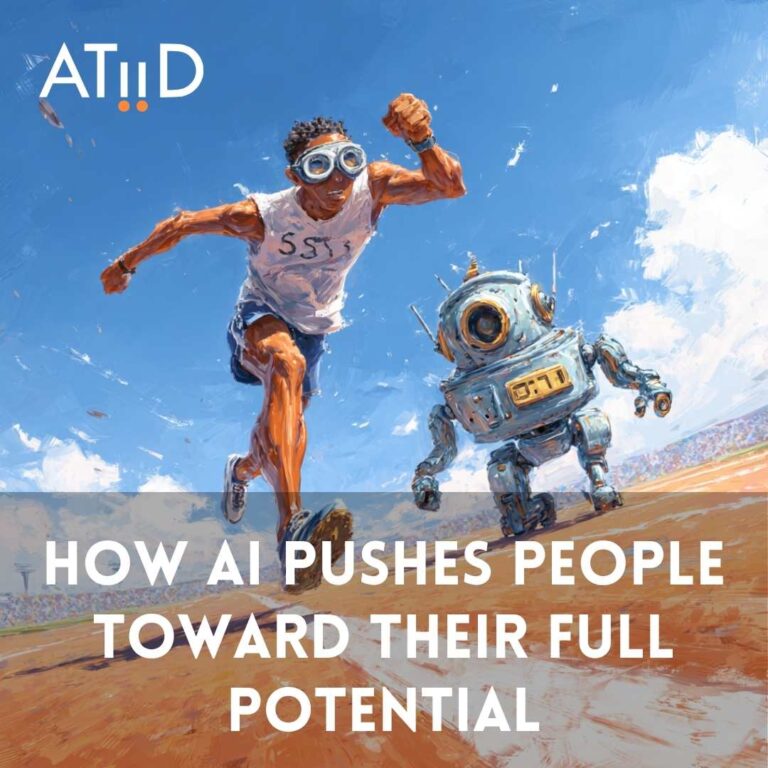
How AI Pushes People Toward Their Full Potential
The Paper Era: When Accuracy Was a Human Problem
Before computers, the office ran on paper. Every transaction, every customer record, every inventory count lived in a ledger written by hand. And because humans were writing it, humans were also getting it wrong.
So organizations built redundancy into their workforce. Someone wrote the number down. Someone else checked it. A third person might reconcile it at month-end. Entire layers of staffing existed not to do more work, but to catch the errors in the work that had already been done.
It wasn’t glamorous. It wasn’t strategic. But it was necessary, because the margin for error in a manual world was significant, and the cost of bad data was real.
The Computer Era: Reducing the Cost of Being Wrong
The personal computer changed the equation. Suddenly, data could be recorded faster, stored more reliably, and checked automatically. Spreadsheets caught calculation errors. Databases enforced data integrity. Software flagged inconsistencies before they made it into a report.
The need for human double-checking of basic data dropped dramatically. And as a result, the workforce expanded into new roles, not checking each other’s arithmetic, but managing larger and larger volumes of information.
This was progress. Real, meaningful progress. But it came with a subtle trap: a vast amount of modern knowledge work became, at its core, data tracking. Managing records. Updating systems. Generating reports that summarized information other systems had already processed.
The work wasn’t particularly hard. It was voluminous. And in many organizations, the ability to manage that volume, to keep the systems current, the reports clean, the data flowing, became the primary definition of a good employee.
The AI Era: When the Overhead Disappears
We are entering a third era. And it is unlike the previous two.
In the paper era, humans managed data manually. In the computer era, humans managed data digitally. In the AI era, data management, collection, analysis, synthesis, reporting, will increasingly be handled by machines without meaningful human intervention.
AI will not just record what happened. It will tell you what it means. It will surface the patterns, flag the anomalies, project the outcomes, and draft the first recommendation. It will do in seconds what used to take a team days.
That’s an extraordinary gift. And it comes with an extraordinary demand.
Because when AI handles the information layer of work, the tracking, the reporting, the analysis, what is left for people to do? The answer is both simple and profound:
The hard stuff.
The decisions that carry real risk. The relationships that require trust. The strategies that determine whether a company grows or contracts. The conversations that require empathy, judgment, and the kind of nuanced read on a room that no algorithm can replicate.
As we’ve explored in past ATiiD posts, AI is going to remove the busywork that many people have unconsciously used as a buffer between themselves and the harder, more exposed parts of their jobs. The prep work that felt productive but was quietly a form of avoidance. The reports that felt valuable but were really just formatted data.
AI takes that away. And what it exposes underneath is the actual work of business, the work that has always been there, always been the hardest, and always mattered most.
The Core of Human Value: Decisions and Influence
Strip away every technological era, paper, computers, AI, and the core challenge of business has never changed. Someone has to decide. Someone has to convince others. Someone has to take accountability for outcomes that cannot be perfectly predicted.
This is where risk lives. Not in a spreadsheet. Not in a database. In a decision.
Strategic Decision-Making
Every organization faces inflection points: which markets to enter, which products to cut, which people to promote, which partners to trust. These decisions don’t have objectively correct answers. They have better or worse answers, and the difference comes down to the judgment of the people making them.
AI can model scenarios. It can simulate outcomes. It can present probabilities. But it cannot make the call. It cannot feel the weight of a decision or own the responsibility for what comes next. That responsibility belongs to humans. Always has. Always will.
In an AI-augmented world, the leaders who thrive will be those who can take AI’s outputs, its models, its recommendations, its risk assessments, and exercise sound judgment on top of them. Not defer to the machine. Not ignore it. Direct it.
Influence and People Skills
Decisions rarely succeed on their merits alone. A brilliant strategy that nobody believes in is a failed strategy. An accurate diagnosis that a patient refuses to accept changes nothing.
The ability to communicate with clarity, to build trust across relationships, to navigate conflict, to inspire action in others, these are the capabilities that determine whether a good idea becomes a real outcome.
AI cannot do any of this. It can draft a message. It cannot build a relationship. It can summarize a meeting. It cannot read the room. It can generate a proposal. It cannot earn the room’s buy-in.
The human who understands this, who invests in developing genuine influence, not just competence, becomes exponentially more valuable in an AI world. Because AI is raising the floor of organizational output. The ceiling is still set by people.
This Is the Opportunity, Not the Threat
There’s a version of this story that’s scary. AI replaces jobs. People become obsolete. Organizations downsize. It’s a real concern worth taking seriously.
But there’s another version, and we believe it’s the more accurate one. AI eliminates the work that was never the fullest expression of anyone’s potential. Nobody’s greatest professional achievement was entering data accurately or formatting a report correctly. That was overhead. Necessary overhead, but overhead.
What AI creates is the possibility, perhaps the first real possibility at scale, for people to spend the majority of their professional energy on the work that actually matters. The thinking. The deciding. The connecting. The leading.
That’s not a threat to human potential. That’s an invitation to it.
The organizations and individuals who recognize this shift early, who start building the muscles of strategic thinking and human influence now, before AI makes it mandatory, are the ones who will define what excellent looks like in the next decade of business.
Ready to Unlock Your Organization's Human Potential?
At ATiiD, this is exactly what we help companies navigate. We don’t just implement AI tools, we help organizations redesign their workforce around what people do best, so that AI handles the overhead and your people show up to do the work that actually moves the business.
Our services are built for this moment:
- AI Leader Launch Program: Build internal AI leadership that knows how to direct, validate, and leverage AI strategically
- Workforce Training: Develop the strategic thinking and influence skills your team needs to thrive alongside AI
- Business Process Optimization: Map your current workflows to identify exactly where AI should take over and where human judgment must remain
- Future State Analysis: Design the workforce model your business needs, not for today, but for the next five years
- Roadmap & Implementation: Move from vision to execution with a clear, practical AI adoption plan built around your people
The companies winning with AI right now aren’t just the ones with the best technology. They’re the ones with the clearest understanding of what their people should stop doing, and what they should become.