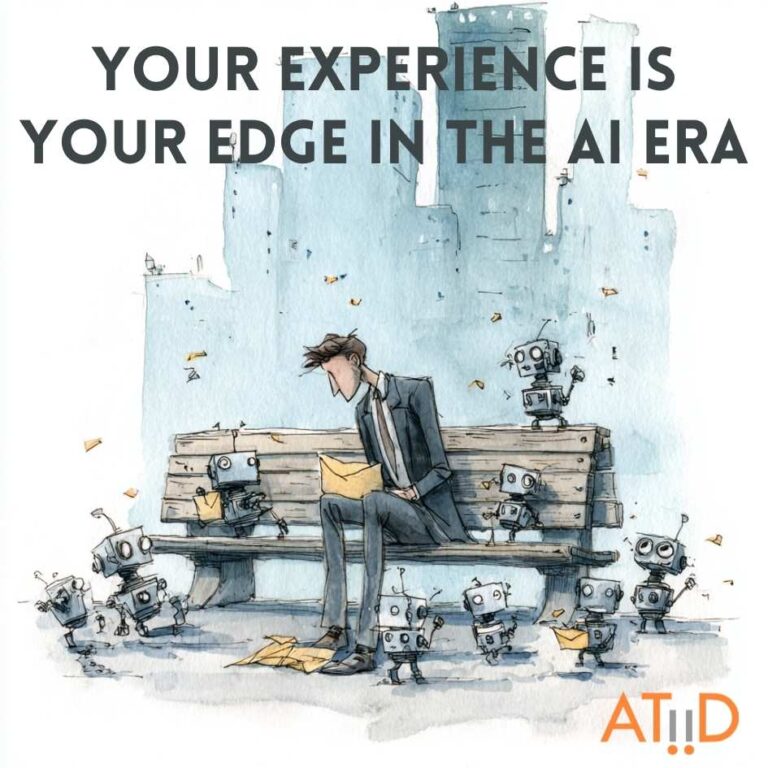
Your Experience Is Your Edge in the AI Era
If you’ve felt that quiet anxiety about AI replacing jobs, you’re not alone — and you’re not wrong to take it seriously.
Every major technological shift has created fear. The printing press, the steam engine, the internet. Each wave sparked the same question: “What happens to me?”
Now it’s AI.
But here’s the truth most headlines miss: AI is very good at generating answers. It is not very good at knowing which answer is right.
And that difference? That’s where your experience becomes the most valuable asset in the room.
AI Gives Answers. Experience Knows Which One Matters.
Imagine a manufacturer deploying an AI tool to optimize production scheduling. The outputs look clean. The logic seems sound. But a 22-year floor supervisor catches something the model couldn’t: a supplier relationship that has been quietly degrading for six months. The AI had no way to know. She does.
That’s not a hypothetical edge case. That’s the pattern playing out across industries right now.
In healthcare, AI can flag anomalies in patient records faster than any clinician. But experienced nurses know which anomalies are artifacts of a poorly calibrated device and which ones signal something real. The algorithm doesn’t have that context — and never will without human oversight.
In professional services (accounting, law, consulting ), AI can draft a memo, synthesize a contract, or produce a market analysis in minutes. But the partner who’s navigated three recessions, two regulatory overhauls, and a hundred difficult client conversations knows which memo will land, which contract clause will matter, and which analysis will actually change a decision.
AI doesn’t have scar tissue. You do.
The Pace Will Accelerate - And That's a Warning
AI doesn’t just change what we do. It changes how fast we do it.
Projects that once took weeks may take days. Research that once required hours may take minutes. McKinsey’s November 2025 report found that current AI technologies could already automate 57% of U.S. work hours, not by 2030, but right now with tools that exist today. That’s nearly double their estimate from just two years ago.
That speed magnifies impact. For better or worse.
An inexperienced employee running fast with flawed AI outputs can cause real damage: incorrect pricing sent to a major client, a compliance filing with bad assumptions, a hiring recommendation built on biased training data. The World Economic Forum’s 2025 Future of Jobs Report found that analytical thinking, the ability to evaluate AI outputs critically and make sound judgments, is now the single most sought-after skill by employers, with 7 out of 10 companies calling it essential. And yet 63% of employers cite the skills gap as their biggest barrier to AI transformation.
Speed without judgment is dangerous.
This is why businesses desperately need people who can move quickly and wisely. People who don’t require constant supervision. People who can evaluate a machine’s output and say, confidently, “This is right” or “This is going to blow up.”
That is not entry-level work. That is seasoned judgment.
Your New Role: Strategic Validator
In the AI-augmented workplace, the value of experience doesn’t disappear, it shifts.
The simple tasks you were once hired to do? AI handles many of those now. But the complex judgment calls you’ve accumulated over a career? That’s where your value multiplies.
Experienced professionals are becoming:
-
Strategic validators — quality control for AI outputs before they reach customers or leadership
-
Context carriers — the institutional memory that no model can replicate
-
Decision-makers, not task-doers — the final sign-off on high-stakes calls
-
AI translators — bridging the gap between what the business needs and what the machine produces
-
Guides for younger staff — helping less experienced colleagues develop the critical eye AI tools require
The person who understands the business deeply will know how to prompt AI effectively. They’ll know when to push back. They’ll know when to trust the output, and when to override it.
What You Should Do Right Now
This isn’t a moment to retreat or protect your current responsibilities. It’s a moment to lean forward. Here’s a practical framework to start:
-
Audit your expertise. Write down the top five things you know that aren’t in any manual, training document, or database. That’s your AI-proof value. Protect it. Develop it.
-
Learn the tools, don’t fear them. You don’t need to become a data scientist. You need to understand what AI can and can’t do in your domain well enough to spot errors and ask better questions.
-
Reframe your role. Stop measuring your value by how many tasks you complete. Start measuring it by the quality of decisions you influence. In an AI world, that’s the new scoreboard.
-
Become the bridge. The most valuable person in any AI implementation isn’t the technologist. It’s the experienced professional who can translate between business reality and machine output, and make leadership confident in the result.
-
Speak up early. When your organization starts piloting AI tools, volunteer to be part of the evaluation. Your experience gives you a perspective no algorithm can provide.
A Word to Business Leaders
Organizations that rush to replace experienced professionals with cheaper labor amplified by AI are taking a real risk.
Unsupervised AI use by employees who lack business context can cause harm that’s expensive, and sometimes irreversible. Trust, reputation, and customer relationships take years to build and seconds to lose.
The companies that thrive in the AI era will pair technology with experienced oversight, redesign roles thoughtfully rather than cutting blindly, and empower seasoned professionals to lead the adoption process, not resist it.
At ATiiD, we call this people-first AI. The businesses we work with, from manufacturing operations in Ohio to professional services firms in Pittsburgh, have found that their most successful AI implementations weren’t driven by the technology. They were driven by the experienced people who knew how to use it correctly.
The Bottom Line
AI may move fast.
But wisdom moves correctly.
And in a world that’s accelerating beyond anyone’s predictions, correctness matters more than speed alone.
Your experience is not obsolete. It’s not a liability. It’s the stabilizer that separates businesses that scale intelligently from those that crash quickly.
The organizations that understand that will be the ones that thrive.
Wondering where your organization stands on AI readiness, and how to turn your team’s experience into a competitive advantage? Our Leader Launch Program is a 2-hour executive workshop designed to give your leadership team clarity, confidence, and a clear roadmap forward. Investment starts at $1,997.