Not Most Knowledge but Most Skilled (Employees)
For decades, success in white‑collar work followed a familiar script: get a degree, accumulate knowledge, climb the ladder. But that script is being rewritten in real time. In an AI‑driven world, knowledge alone no longer sets you apart, because AI already has it.
What matters now is skill: how you use knowledge, how you think strategically, and how you turn information into outcomes.
AI Has the Knowledge, You Provide the Judgment
As time goes on, AI will become better at research, summarization, data analysis, and generating ideas in seconds. That means relying on credentials as proof of value will become less relevant. Your edge will come from asking the right questions, connecting ideas across contexts, and deciding what actually matters.
In other words: strategy beats storage.
Henry Ford Figured This Out a Century Ago
This idea that strategic skill matters more than raw knowledge isn’t new. One of the most striking historical examples comes from Henry Ford, a man often underestimated in his time.
Early in his career, Ford was challenged in court and publicly criticized, not for fraud, incompetence, or malfeasance, but for something that sounds astonishing today: people questioned whether he was intelligent enough to run a massive enterprise like Ford Motor Company. Critics pointed to his lack of formal education, he left school around age 16 after completing eighth grade, as evidence that he didn’t have the intellectual foundation to manage a business of unprecedented scale.
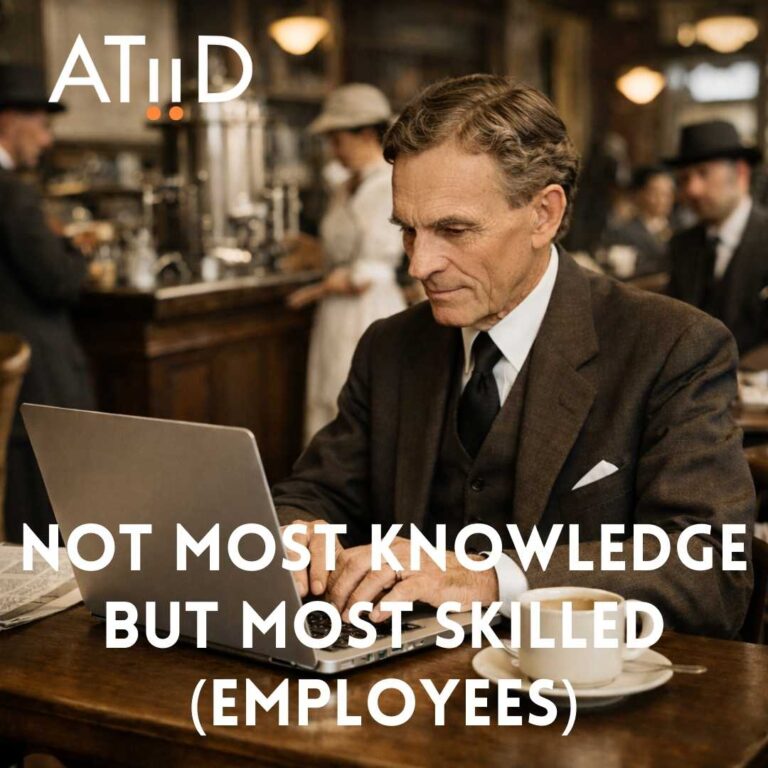
Ford’s response was both simple and brilliant. He famously retorted that he had a row of electric buttons on his desk, allowing him to summon experts who could answer any question, asking why he should “clutter up my mind with general knowledge” when he had people to supply it. Here, he recognized that knowledge could be accessed when needed, and that his true skill was in knowing where to find the right information and how to apply it to practical problems.
That mindset reflects a deeper truth: business success is grounded not in the breadth of what you know, but in your ability to organize people, resources, and processes to solve real problems. Ford didn’t build every component of the automobile. He didn’t invent the internal combustion engine. What he did do was orchestrate a system, one that integrated technology, people, and process, to create unprecedented value.
Today, that “push a button” metaphor is literal. With AI, we truly can access vast knowledge instantly. But access isn’t the differentiator. The differentiator is how we leverage that access to make decisions, solve problems, and create value.
You Can Be a Modern‑Day Henry Ford
AI now gives every employee access to expertise that once required teams of analysts. But access alone doesn’t create value. The employees who thrive will be those who:
-
Think in terms of business impact, not tasks
-
Use AI to explore options, not blindly accept answers
-
Translate insights into decisions and action
-
Adapt quickly as tools and roles evolve
Degrees may still open doors, but strategic thinking keeps you relevant.
Proof That Skill Beats Credentials
History is full of successful business leaders who didn’t rely on formal education:
- Henry Ford – eighth‑grade education
- Andrew Carnegie – left school early to work
- Richard Branson – dyslexic, left school at 16
- David Karp (Tumblr) – dropped out of high school
- Daymond John – built FUBU without a college degree
What they shared wasn’t formal knowledge, it was grit, curiosity, and strategic instinct.
The Takeaway for Employees
In an AI world, your career isn’t protected by what you know, it’s protected by how well you use what AI knows. Learn to think like a strategist. Learn to frame problems. Learn to decide.
That’s how you become indispensable.
Want to Lead the AI Transformation?
Henry Ford had his row of buttons. You have something far more powerful, if you know how to use it. ATiiD’s Leader Launch Program gives your leadership team the clarity, confidence, and strategic framework to turn AI from a source of anxiety into your competitive advantage. Click here to learn more and stop guessing, start leading.